Airbnb’s new house rules policy applies to reservations booked on or after November 20, 2026. The booking date matters: a stay that starts later but was booked before November 20 falls under the earlier policy. Airbnb has already changed how hosts enter and display rules in the Listing editor, so hosts can review their setup before the policy takes effect. Airbnb’s host announcement and policy are the controlling sources.
The practical shift is clear: Airbnb wants guests to know the requirements before they book, and it generally does not want a cleaning checklist handed to them at checkout. This guide separates what Airbnb says from what guests and hosts are debating, then offers a workable way to update a listing and turnover process.
The change in one minute
| Topic | Airbnb’s stated approach | Host action |
|---|---|---|
| Standard rules | Choose from seven areas: maximum overnight guests, quiet hours, events, pets, smoking, commercial photography and locking up at checkout. | Review each setting in the Listing editor. |
| Other instructions | Add reasonable requests in the designated House rules and requests section. Guests must follow house rules and are encouraged to comply with requests. | Put permitted instructions in the right field before booking. |
| Checkout chores | Generally, do not ask guests to strip beds, take trash offsite, or wash and put away dishes. | Move cleaning work into the turnover plan. |
| Advertised amenities and fines | Generally, do not restrict an advertised feature or impose host fines. Fees for advertised features must appear in the booking price. | Review amenity claims, optional extras and penalty language. |
| Contracts and guest data | Separate contracts and collection of personal data are restricted, with specific exceptions. | Check registration, ID, access and contract workflows. |
These are general rules, not a promise that every possible request has a universal yes or no answer. Airbnb says it considers the listing, type of stay and local circumstances and may grant exceptions. Source: Airbnb policy.
What can Airbnb hosts ask guests to do at checkout?
Airbnb’s examples draw a useful line between a quick departure step and work normally done by a cleaner:
| Airbnb says hosts can ask | Airbnb says hosts generally should not ask |
|---|---|
| Put used dishes in the sink. | Wash and put away dishes. |
| Gather used towels. | Strip the bed or start a laundry load. |
| Separate trash and recycling into designated indoor bins. | Take trash offsite. |
| Turn off air conditioning when leaving. | Avoid using air conditioning when it is advertised. |
Those examples come from Airbnb’s host announcement. Airbnb does not say guests may damage a home or ignore all instructions. Its guest ground rules still apply, and reasonable, disclosed requests remain possible. Context matters: Airbnb gives drought restrictions and animal-proof trash containers in bear country as examples where an exception may be reasonable.
The cleaning fee does not create a separate policy test. Airbnb describes the checkout limits generally, whether or not a host charges one. But a visible cleaning fee paired with a long chore list is exactly the combination many travelers say feels unfair.
Rules must be visible before booking
Airbnb says all house rules and requests belong in the designated section of the listing when the guest books. A host cannot add new requirements elsewhere in the description, in a later message, on a sign inside the property or in person. The information must also agree with the rest of the listing. Airbnb says it will show rules more prominently and include them in reservation reminders. Sources: Airbnb policy, host announcement.
This makes a pre-arrival message useful as a reminder, not a place to introduce another obligation. It also means hosts should audit scheduled messages, house manuals, QR-code guides and signs against the listing, not just edit the seven standard settings.
Contracts, ID requests and access apps need a separate review
Airbnb’s related policy generally bars home hosts from requiring a separate contract, asking for personal data such as a passport copy, or requiring a third-party app to access the listing or a critical amenity. Exceptions include applicable law, documented community association or building-security rules, certain monthly stays, Luxe listings and contracts for some optional amenities. A host may disclose an in-person ID check, but generally cannot keep a copy. When an exception applies, Airbnb says to disclose what is needed and why before booking and collect no more data than necessary.
Do not assume a building’s customary process automatically qualifies. Obtain the actual requirement, document it, disclose it in the designated listing section and check the Airbnb policy before relying on an exception. For an optional keyless-entry app, Airbnb says an alternate access method must be available on request. The policy also bars asking guests to review their Airbnb stay or complete a survey on another site, except for hotel listings.
What the supplied Reddit comments suggest
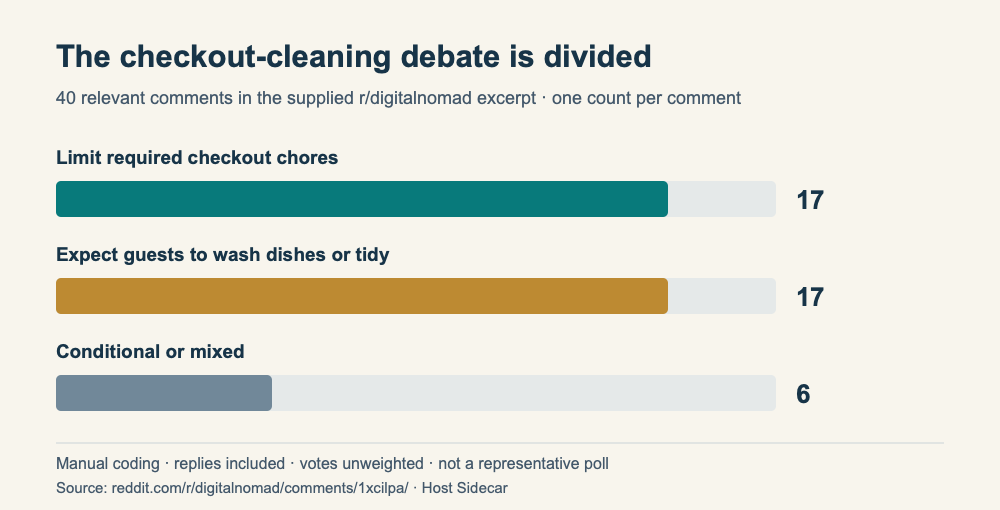
How this graphic was made: I manually coded 40 comments in the reader-supplied excerpt of the r/digitalnomad discussion that expressed a view about guest cleaning duties. Each comment was counted once, including replies; votes were not used as weights. “Conditional” includes comments that distinguish cleaning during a long stay from checkout chores, or that change their view based on the cleaning fee or the size of the mess. Comments about only reviews, passports, hotels or unrelated subjects were excluded. Coding is an editorial judgment, and the excerpt is incomplete. This split describes these comments, not overall host or guest sentiment.
In this coded excerpt, 17 comments favor limits on required checkout chores, 17 expect guests to wash dishes or tidy, and 6 take a conditional or mixed position. The most useful finding is the tension, not a winner: people broadly object to being assigned a turnover job, yet many are uncomfortable leaving dirty dishes. Hosts can respond to both concerns with reasonable during-stay guidance and a cleaner who handles the final reset.
What people are arguing about
The linked r/airbnb_hosts discussion and the r/digitalnomad thread show several recurring positions. They are examples of public reaction, not a representative poll of Airbnb hosts or guests. The threads are self-selected, replies are nested, and comments can be deleted or re-sorted.
| Perspective in the comments | Strongest version of the argument | Practical response |
|---|---|---|
| Guests paying a cleaning fee | A paid stay should not end with cleaner-level chores. Surprise tasks make the total price feel misleading. | Publish a short, lawful checkout request and make the cleaner responsible for turnover. |
| Guests who voluntarily tidy up | Many travelers would wash dishes or straighten a home without being ordered to; leaving a week’s worth of food and dirty dishes feels inconsiderate. | Encourage care during the stay without turning goodwill into a mandatory departure job. |
| Hosts of shared or long stays | In a shared home or a month-long stay, ongoing dishwashing and trash management can be part of living together and preventing pests. | Distinguish everyday use of a shared space from a checkout cleaning assignment. Disclose any request and check whether Airbnb considers it reasonable for that stay. |
| Hosts worried about costs or readiness | If cleaners inherit more work, turnover time, staffing and prices may need adjustment. | Measure actual cleaning time and revise the operating plan or pricing transparently; do not hide chores in later messages. |
| Guests worried about enforcement | A written policy helps only if support applies it consistently and hosts do not add rules after booking. | Keep the listing, saved messages and on-site instructions aligned; use Airbnb support for a real dispute. |
These positions are paraphrases of themes in the r/airbnb_hosts thread and the reader-supplied r/digitalnomad comment excerpt. They should not be read as endorsements. One important distinction often lost in the debate: Airbnb’s example is about requiring guests to wash and put away dishes at checkout. It does not tell people how to live in a kitchen during a longer stay.
My view: hospitality should carry the last mile
Most of us who host are in the hospitality business. I suspect Airbnb is trying to make the guest experience feel more consistent and more valuable; that is my interpretation, not a stated company motive. If we want guests to choose a professionally run stay, the final hour should feel like part of the service.
It is fine to clear your own tray at McDonald’s. At a fine restaurant, nobody hands you a closing checklist and expects you to clear the table. An Airbnb is a home, not a restaurant, but the comparison is useful: the level of service we promise should match the work we expect the customer to do. A guest can be respectful without becoming the turnover crew.
That does not mean leaving a property filthy is acceptable. It means hosts should distinguish ordinary care of a home from labor that prepares it for the next paying guest. Clear expectations, a capable cleaning team and an honest price are better tools than a surprise chore list.
When checkout work moves back to your team
If guests previously stripped beds, started laundry or handled dishes, removing those checkout instructions may add work to the turnover. The host still needs to update the listing, revise saved messages, agree on the cleaner’s scope and make sure the home is ready for the next arrival. Each platform change can create another round of small administrative tasks when time is already tight.
That is where Host Sidecar can help. We configure and maintain the systems behind guest messages and cleaner coordination, then help adjust those workflows when rules or operating needs change. You and your local team still lead hospitality, cleaning and final decisions. See how Host Sidecar works with your existing team.
A host checklist before November 20
- Open every listing’s House rules and requests. Confirm the seven standard settings and remove requests that Airbnb identifies as cleaner work.
- Audit every other guest touchpoint. Compare scheduled messages, checkout notes, manuals and signs with the listing. Remove new requirements that appear only after booking.
- Check your cleaner’s scope. Assign beds, dishes, laundry, trash and final inspection explicitly. Allow enough time for the actual turnover, especially after long stays.
- Review fees and amenities. Ensure an advertised feature is available as described and that its required fee is in the price shown at booking. Review any fine language.
- Review ID, registration and access. Check contracts, building requirements, third-party apps and any personal-data collection against Airbnb’s separate policy.
- Recheck the live policies on November 20. Apply the rule to the reservation’s booking date, document any claimed exception and avoid assuming support will approve it.
A shorter checkout request
Before you leave, please lock the door, turn off the air conditioning and place used dishes in the sink. You can leave used towels together in the bathroom. Our cleaning team will take care of the rest.
Use only the parts that fit your listing and Airbnb’s current policy; put them in the designated listing section before booking. A friendly reminder may repeat what the guest already saw.
Frequently asked questions
Does the new Airbnb policy apply to stays beginning November 20, 2026?
It applies to reservations booked on or after November 20, 2026, according to Airbnb. The check-in date alone does not decide which version applies.
Can an Airbnb host ask guests to wash dishes?
Airbnb says hosts generally should not ask guests to wash and put away dishes as a checkout task. Its permitted example is asking guests to place used dishes in the sink. For shared homes or longer stays, review the full policy and the context of any everyday request.
Can hosts still ask guests to take out trash?
Airbnb says hosts generally should not require guests to take trash offsite. It says sorting trash and recycling into designated indoor bins can be a reasonable request. Local conditions may justify exceptions, such as an animal-proof container in bear country.
Are cleaning fees banned?
No. The new house-rules policy limits unreasonable tasks and requires price transparency; it does not announce a ban on cleaning fees.
Can a host add house rules after booking?
Airbnb says house rules and requests must be disclosed in the designated listing section at booking. New requirements cannot be added afterward by message, sign or in person.
Sources and editorial note: Airbnb house-rules announcement; Airbnb reasonable house rules policy; Airbnb contracts and data policy; r/airbnb_hosts discussion; r/digitalnomad discussion. Policy statements above come from Airbnb. Reddit supplies perspectives, not verified facts about policy or a statistically valid survey.