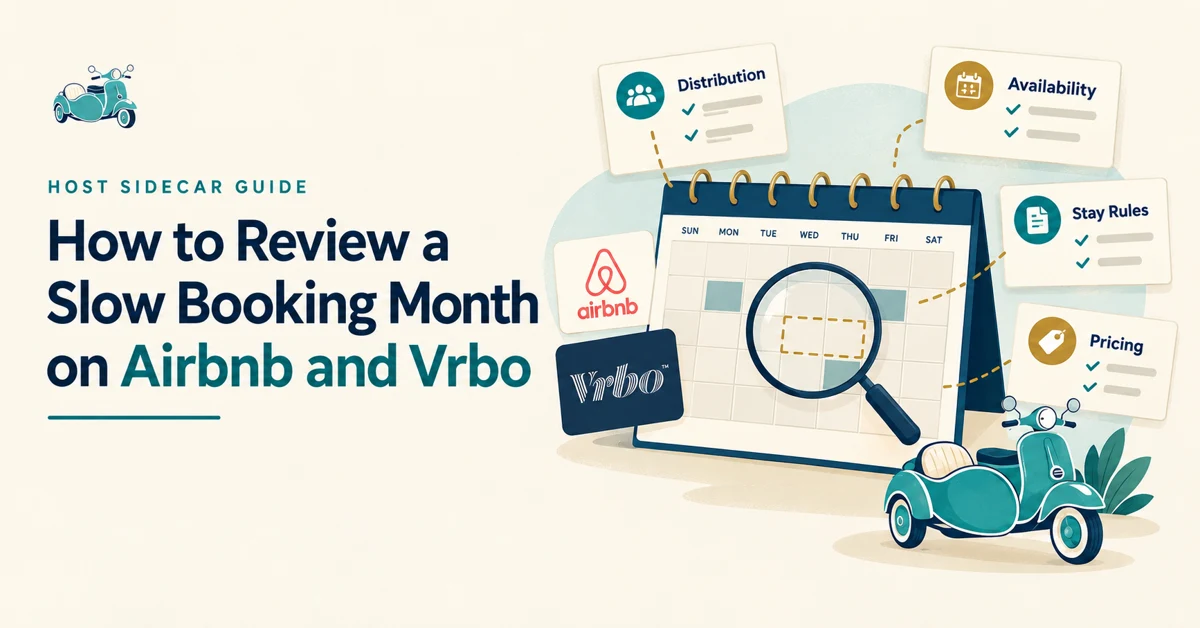
To review a slow booking month, check whether useful dates are actually bookable, listings are accurate on each channel, and total prices fit comparable stays. Review distribution and stay rules before assuming a discount is the right answer.
How to put this into practice
- Confirm the property is active and accurately represented on each intended channel.
- Check calendar blocks and stay restrictions for the open dates.
- Compare guest totals and net results for equivalent stays.
- Track any pricing experiment against comparable periods and seasonality.
Download calendar-sync instructions (PDF)
Summary
- Check distribution, availability, and stay rules before discounting a slow month.
- iCal shares blocked dates with limitations; supported PMS connections can coordinate more of the work.
- Test channel pricing against net results, not assumptions about platform algorithms.
A slow month does not always mean the property is the problem
An unusually open calendar can tempt you to discount. First check availability, distribution, and listing accuracy.
Ask:
Is the property available on both Airbnb and Vrbo?
Are the calendars blocking the same dates?
Are new reservations appearing quickly on every platform?
Are minimum-stay rules preventing shorter bookings?
Is the pricing competitive on each channel?
Are the listing photos, amenities, and descriptions current?
Is one platform receiving more attention than the other?
A slow month may reveal an operating issue rather than a demand problem.
More than one platform creates more booking opportunities
Airbnb and Vrbo compete for travelers, hosts, and bookings. That does not mean they automatically increase your listing’s ranking because you use both platforms.
It does mean that publishing a property on more than one appropriate channel gives the property more chances to be seen and booked.
If one platform is quiet, the other may perform better for that period, property type, guest profile, or travel purpose. The advantage comes from having coordinated access to both channels—not from assuming that either platform knows or cares exactly where every other booking originated.
Calendar sync is the foundation
A double booking can damage guest trust, create emergency work, and lead to cancellations or refunds. That makes calendar accuracy one of the most important parts of multi-platform operations.
iCal links can help by sharing blocked dates between platforms. For example:
Export the Airbnb calendar.
Import the Airbnb iCal link into Vrbo.
Export the Vrbo calendar.
Import the Vrbo iCal link back into Airbnb.
Verify that blocked dates appear correctly in both places.
This is useful when calendar import is available for both accounts. Vrbo does not offer its manual calendar-import feature for PMS-managed properties. Follow the two-way calendar-sync guide and verify the resulting availability; iCal is not a complete operating system.
Why iCal links are not foolproof
iCal calendar syncing has limitations:
Imported calendars may not re-export to other platforms.
Updates may take time to appear.
Calendar sync blocks dates but does not sync pricing.
It does not sync guest details or messages.
A reservation change may not be reflected immediately.
A missed or broken link can create false confidence.
The system does not create one central source of truth.
A newly booked stay may still be waiting to reach another platform even when the calendars looked correct a moment earlier.
A PMS provides a stronger operating layer
A property management system, or PMS, can centralize reservations and connect supported channels through a more coordinated system.
Depending on the PMS and channel connections, this may provide:
Faster availability updates
One central reservation record
Coordinated calendars
More reliable booking change management
Centralized guest communication
Turnover scheduling
Owner reporting
Better operational visibility
A PMS does not make every channel identical, and no system eliminates every risk. But it can provide much faster and more dependable synchronization than relying only on exchanged iCal links.
The benefit is coordinated availability, not a platform becoming “jealous” of bookings elsewhere.
Can different prices make the platforms compete?
A small pricing difference between Airbnb and Vrbo can sometimes be a useful channel strategy, especially if one platform is producing fewer bookings.
For example, an owner-host may test a slightly more attractive guest-facing price on the quieter channel while accounting for:
Platform fees
Taxes
Payment processing
Discounts
Cancellation policies
Guest expectations
Net earnings rather than headline price
This may help shift demand toward the quieter channel. It does not guarantee that a platform will rank the property higher or change its behavior because another platform is receiving bookings.
Use pricing differences as a measured experiment—not as a secret algorithm tactic.
Review the results over time. Compare bookings, net revenue, lead time, guest quality, and cancellation behavior before deciding whether the strategy is working.
Connect your Airbnb and Vrbo calendars
Follow the tutorial online or keep the instructions handy as a printable PDF.
Frequently asked questions
Should I discount as soon as bookings slow down?
First inspect bookability, distribution, listing accuracy, and booking lead time. A rate change may help, but it will not fix blocked dates or unclear property information.
Does listing on both Airbnb and Vrbo guarantee more bookings?
No. Multiple channels can increase distribution, but demand, guest fit, price, and reliable availability still determine whether the property books.